An AIOS is an AI Operating System.
That sounds big, but the idea is friendly: an AIOS is a place where AI is not just a chat box off to the side. It is part of the working environment. It can see the right context, use the right tools, remember useful knowledge, follow rules, and help people move real work forward.
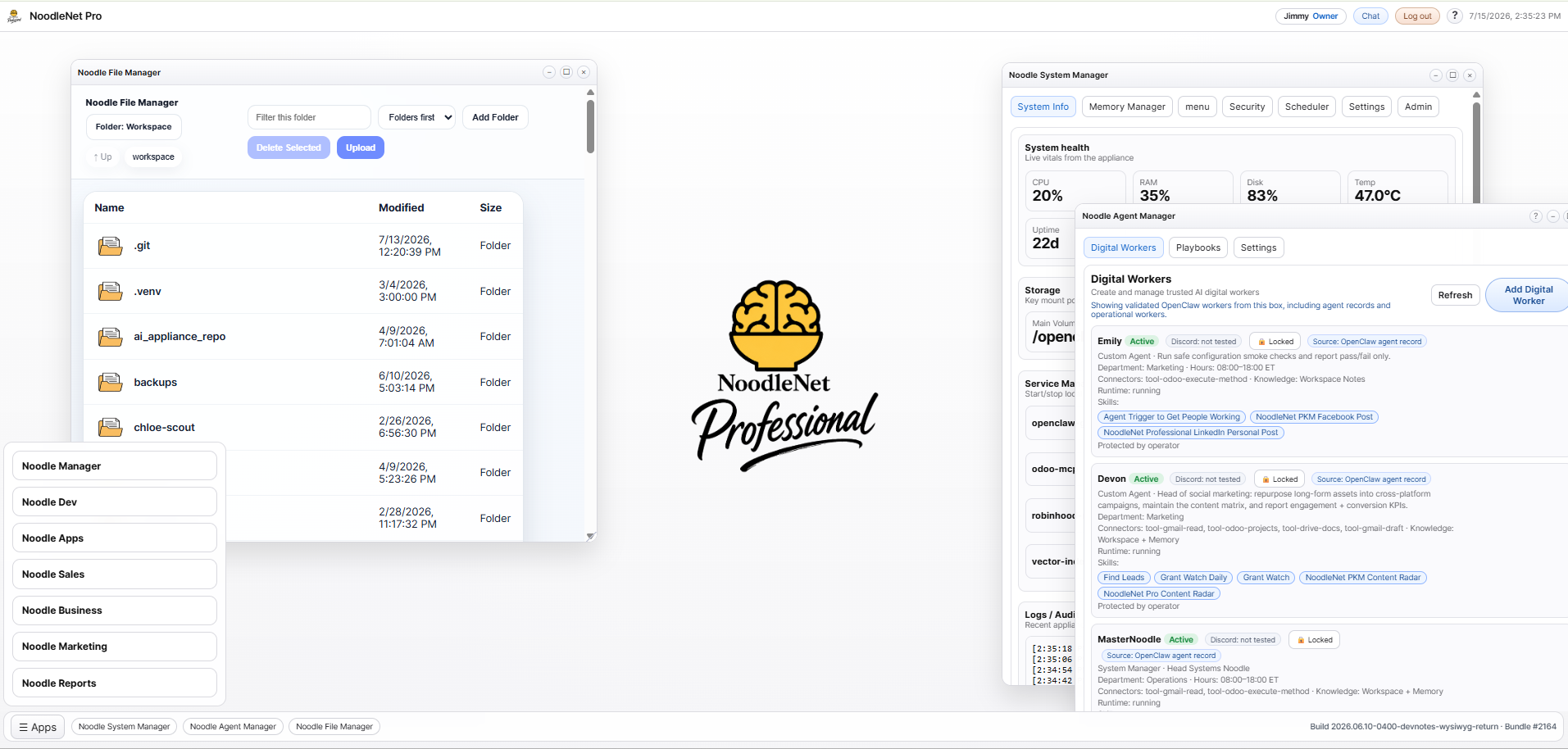
That is the direction behind NoodleNet. NoodleNet BASIC starts with a practical version of the idea: give a small business a cleaner layer for approved knowledge, Ask, connectors, playbooks, files, and human-controlled AI workers.
The simple version
A normal operating system helps people and programs use the computer: files, windows, permissions, memory, apps, and background services.
An AIOS adds an intelligence layer on top of that kind of thinking. It asks:
- What knowledge should the AI use?
- What tools is it allowed to touch?
- Which worker or playbook should handle this job?
- What needs human approval?
- What should be logged so the business can trust what happened?
So an AIOS is not just about having a smarter model. It is about creating a responsible environment for AI-assisted work.
Why a chatbot is not enough
Chatbots are useful. They can draft, summarize, brainstorm, and answer questions. But a chatbot usually depends on what you paste into it in the moment.
A business needs more than that.
It needs AI that can work from approved documents, current policies, customer context, files, repeatable workflows, and clear boundaries. It needs memory without chaos. It needs automation without losing control. It needs a way to turn scattered business knowledge into something the team can actually use.
That is where the AIOS idea becomes important.
The five parts of an AIOS
1. Knowledge
AI becomes more useful when it can work from the business's own material: documents, notes, FAQs, policies, offers, sales language, and operating procedures.
In NoodleNet BASIC, this is why Ask matters. The point is not to ask a model to guess. The point is to help the system answer from the knowledge the business has chosen to trust.
2. Tools
An AIOS gives AI controlled access to useful tools. That might mean search, files, forms, connectors, calendars, CRM data, email, or custom business apps.
The word controlled matters. The goal is not to let AI wander around freely. The goal is to give it the right tool for the right job with the right limits.
3. Workers
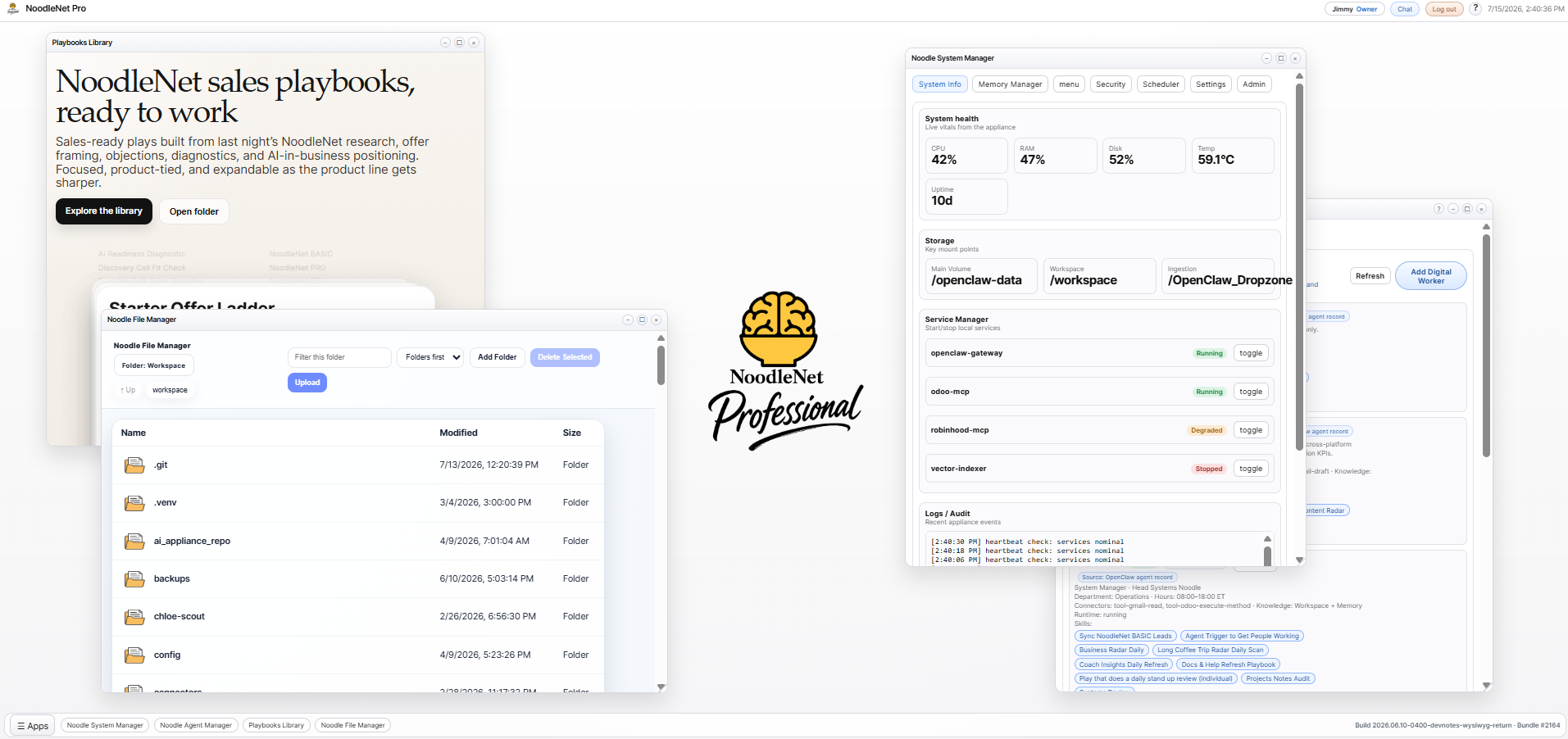
As AI becomes part of daily operations, one general assistant is not always enough. A business may want different AI workers for different kinds of work: sales follow-up, support research, document review, operations checks, or content preparation.
NoodleNet treats workers as part of the operating layer. They are not magic people. They are configured roles with access, instructions, skills, and boundaries.
4. Playbooks
A playbook is a repeatable way to do work.
Instead of asking from scratch every time, a business can define patterns: refresh the knowledge base, prepare a customer brief, review a lead, draft a follow-up, check a policy, or package a report.
That is one of the big differences between AI as a novelty and AI as infrastructure. A good AIOS helps useful work become repeatable.
5. Governance
This is the part that makes the system business-safe.
Governance means permissions, approvals, logs, review steps, and clear limits. It helps answer basic questions: who asked for this, what did the AI use, what did it change, and where should a person stay in the loop?
Without governance, AI can feel impressive but risky. With governance, it can become a dependable part of the way the business runs.
The research vision
Researchers are starting to describe this same shift in more formal terms.
The paper AIOS: LLM Agent Operating System describes an operating-system-style layer for LLM agents, including scheduling, context management, memory, storage, access control, and tool management.
The survey The Rise and Potential of Large Language Model Based Agents explains why LLM-based agents need more than raw model intelligence: they need perception, action, memory, and coordination.
A newer systems paper, Agent Operating Systems (AOS), frames the idea around agentic control planes, observability, policy, trust enforcement, and auditability.
Those papers are technical, but the practical takeaway is simple: as AI moves from answering prompts to doing work, it needs an operating layer.
What makes NoodleNet's version practical
NoodleNet is friendly to the AIOS vision because it starts where small businesses actually are.
Most teams do not need a futuristic command center on day one. They need a place to put knowledge, ask better questions, connect useful tools, organize repeatable plays, and keep control over what AI is allowed to do.
That is why NoodleNet BASIC focuses on a grounded first step:
- a workspace for business knowledge
- Ask for approved recall
- connectors for the places work already lives
- playbooks for repeatable tasks
- digital workers with defined roles
- system controls that keep the operator in charge
It is AIOS as a working base layer, not a buzzword.
A good mental model
Think of an AIOS as the difference between hiring one brilliant intern with no desk, no files, no tools, and no manager, versus giving a team a real office with folders, procedures, equipment, permissions, and supervisors.
The intelligence matters. But the environment matters too.
NoodleNet is building that environment for business AI: not just smarter answers, but a calmer place where knowledge, tools, workers, playbooks, and human judgment can work together.
Bottom line
An AIOS is the operating layer for AI-assisted work.
It brings together models, knowledge, tools, workers, playbooks, and governance so AI can become useful in the real world without becoming messy or uncontrolled.
That is the promise NoodleNet is moving toward: AI that does not just talk about the business, but helps the business remember, organize, decide, and act with more confidence.